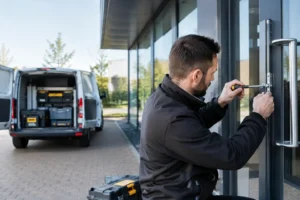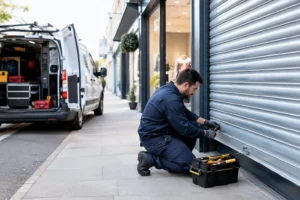

A lost office key is rarely just a lost key. It may give a former employee access to stock, client files, IT equipment or a building that is empty overnight. A commercial locksmith for offices helps you deal with that risk properly, whether the problem is an immediate lockout, a damaged door lock or an access arrangement that has gradually become difficult to control.
For office managers and business owners, the right answer is not always to replace every lock. Sometimes a repair will restore security at a sensible cost. In other cases, rekeying a cylinder or fitting a better suited lock is the safer long-term choice. The key is having the issue assessed by a locksmith who explains the options plainly rather than pushing a one-size-fits-all solution.
When a commercial locksmith for offices is needed
Office lock problems often appear at the worst possible moment: just before opening, after the last person has left, or when a keyholder cannot get into the building. A key snapped in a lock, a failed uPVC multipoint mechanism, a faulty door closer or a worn cylinder can all stop staff getting in or leave premises insecure.
There are also less urgent reasons to call. Perhaps keys have been handed around for years and nobody can say how many copies are in circulation. Maybe a tenant has moved out, a cleaner has changed, or a staff member has left without returning their keys. These are access-control issues, not simply key-cutting jobs, and they deserve a planned response.
For businesses across Reading, Berkshire and the Thames Valley, local attendance matters when a door will not secure at closing time. A direct, experienced locksmith can assess the door and hardware on site, make it safe, and advise what needs doing next without leaving you to negotiate a national call centre.
Repair, rekey or replace?
The most useful commercial locksmith advice starts with the condition of the existing lock and the reason for the call.
A repair may be enough where the lock is sound but has developed a mechanical fault. On aluminium, timber and uPVC office doors, the problem is sometimes a misaligned keep, worn handle, damaged gearbox or door movement rather than the lock cylinder itself. Replacing parts unnecessarily can add cost without solving the underlying cause.
Rekeying is often the sensible option after keys are lost, not returned, or held by people who should no longer have access. Depending on the lock type, the cylinder can be changed so that old keys no longer work while the rest of the door furniture remains in place. This is generally quicker and less disruptive than replacing a complete lock case.
Replacement is the right choice when the hardware is worn, damaged after an attempted break-in, unsuitable for the door, or no longer provides the level of protection the premises need. An external office entrance may need a quality cylinder matched to the door and its security requirements, while an internal store room could need a different level of control. The best specification depends on the door, the contents behind it and how the building is used.
Cheap replacement locks can look like a saving until they fail early, offer poor key control or do not fit the door correctly. Established lock brands such as Yale, Chubb and Union offer reliable options, but brand alone is not the whole answer. Correct fitting and compatibility with the door are just as important.
Key control is where office security often slips
Many offices are secure on paper but weak in practice. The front door has a good lock, yet spare keys sit in an unlocked drawer, old contractors still have copies, and nobody knows which key opens the comms cupboard or rear exit.
A clear key register is a practical place to start. Record who has each key, what it opens and when it was issued. Keep spare keys in a controlled location, and ask for keys back as part of every leaver and contractor process. It is straightforward administration, but it prevents small gaps becoming expensive security problems.
Where several doors need different permissions, a master key system may help. This can allow a manager to open multiple authorised areas while giving staff keys that only work on the doors they need. It is particularly useful in offices with separate departments, meeting rooms, storage areas and landlord-controlled access.
There is a trade-off. A master-keyed system brings convenience, but it needs proper planning. One lost master key can affect a larger part of the building, so keys must be issued and stored carefully. For some smaller offices, changing individual cylinders and keeping key distribution tight is the simpler approach.
Do not overlook fire doors and emergency exits
Security must never compromise safe escape. Fire doors, escape doors and panic hardware have specific jobs to do, and changes should preserve their ability to open quickly from the inside when the building is occupied.
This is why an office lock should not be selected in isolation. A locksmith needs to consider the door type, the frame, existing hardware, occupancy and how the door is used during the day. A rear door that is secure against unauthorised entry but difficult to use in an emergency is not a successful installation.
If a door closer is slamming, failing to latch or pulling the door out of alignment, deal with it early. Repeated strain can damage locks and make access unreliable. The same applies to uPVC doors that have become difficult to lift, lock or unlock. Forcing a stiff mechanism can turn a manageable adjustment into a complete failure.
What to expect from a dependable office locksmith
Before work begins, you should be able to understand what has failed, what the practical options are and what the likely cost will be. A good locksmith does not need to make the situation sound more complicated than it is.
For an emergency, speed and clear communication are essential. You need to know who is attending, roughly when they will arrive and whether the premises can be made secure that day. For planned work, the focus shifts to minimising disruption: arranging access around staff, identifying the doors involved and agreeing how new keys will be handed over.
When comparing providers, look beyond the initial price. Ask whether there is a callout charge, whether the locksmith can repair as well as replace, and whether they have experience with the type of doors on your site. A business that relies on a local locksmith benefits from being able to speak to the person carrying out the work, particularly when there is a decision to make on site.
Lock Solutions has been helping local businesses and property managers since 2006, with direct contact, 24-hour emergency support and no callout charge. Where an office lock problem cannot wait, the aim is to attend within an hour and get the building secure with the least disruption possible.
A sensible plan after an office lock incident
Once access has been restored, take ten minutes to consider why the problem became urgent. If the keys were lost, decide whether the affected locks should be rekeyed. If a mechanism failed, check whether similar doors are showing the same signs. If a former employee retained a key, review who else has access and whether your records are current.
It is also worth keeping the details of your locks and doors somewhere secure. Note the location of each door, any key numbers, the number of keys issued and previous repairs. This makes future work quicker and avoids guessing when there is a fault outside normal hours.
Office security is not about fitting the most expensive lock on every door. It is about making sure each entrance, exit and restricted area has the right hardware, the right access level and a clear plan when something goes wrong. If a lock is sticking, a key is missing or your office access has become hard to manage, deal with it before the next working day depends on it.