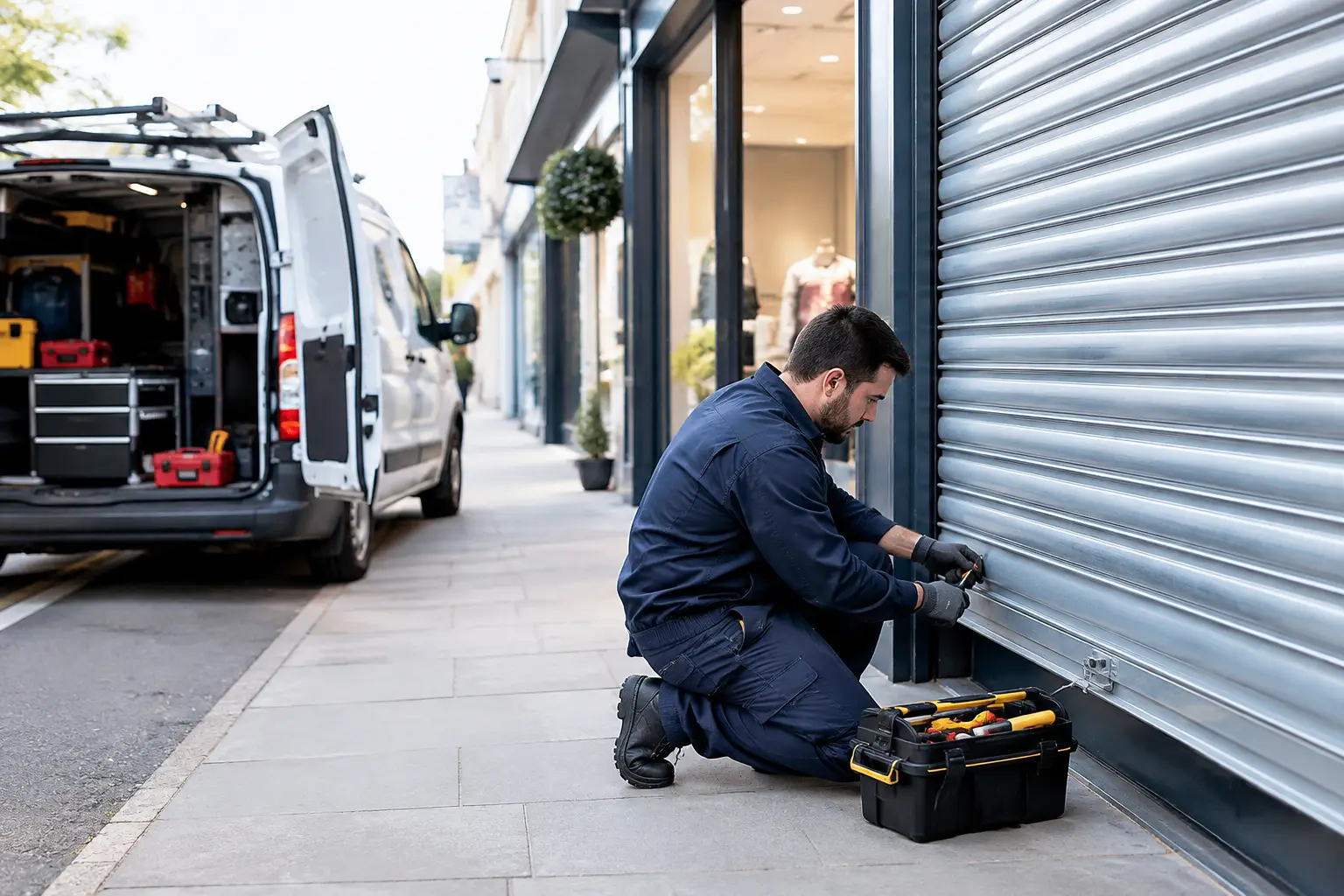
A retail shutter that will not close at the end of a trading day is more than an inconvenience. It can leave stock, tills and staff exposed, force you to delay closing, or mean returning to the premises overnight. Prompt retail shutter repair is about restoring safe access and security, but the right fix depends on what has actually failed.
A shutter may be stuck because of a damaged slat, misaligned guides, a failed motor, a broken spring or a problem with the lock. These faults can look similar from the shop floor, yet they need different repairs. Trying to force a shutter down, lift it by hand or keep operating a faulty motor can turn a manageable repair into a replacement job.
When a shutter fault needs urgent attention
The clearest emergency is a shutter that cannot be secured. If it is left partly open, can be lifted easily, has been forced, or will not lock, the premises need attention straight away. The same applies if a shutter is jammed across an entrance while customers or staff are still inside, especially where it affects a fire exit or the only practical way out.
A damaged shutter after an attempted break-in should be treated as a security issue first. Do not disturb evidence unnecessarily, but take photographs if it is safe to do so and contact the police where appropriate. Then arrange for the opening to be secured. Temporary boarding or a temporary locking solution may be the sensible immediate step while specialist shutter parts are sourced.
Not every problem needs an out-of-hours call. A shutter that is noisy but still opens, closes and locks properly can often be booked in for planned maintenance. That said, unusual grinding, scraping, jerking or repeated tripping should not be ignored for weeks. Those signs often point to wear in the moving parts, and shutters rarely improve through continued use.
Common retail shutter repair problems
The shutter is stuck open or closed
A shutter stuck open may have an obstruction in the guide rails, bent slats, a curtain that has wound unevenly, or an electrical fault. A shutter stuck closed can be caused by a seized lock, damaged bottom rail, failed motor or a release mechanism that is not operating as it should.
Before anyone investigates, isolate the power if the shutter is electrically operated and there is any sign of damaged wiring, burning smells or a motor that is overheating. Do not climb ladders or reach into the shutter box. The tensioned components inside can be dangerous without the correct tools and experience.
The shutter will close but will not lock
This is often a locksmith issue rather than a full shutter mechanism failure. The centre lock, side bolts, keys or locking bars may be worn, damaged or out of alignment. Sometimes the shutter itself has shifted slightly, preventing the lock from engaging cleanly.
A proper assessment should establish whether the lock can be repaired, whether keys are damaged, or whether a replacement lock is the more dependable option. If replacement is needed, it should be suitable for the shutter type and fitted so the lock engages without forcing it.
Damaged slats, rails and bottom sections
Impact from a delivery, vandalism, a vehicle or an attempted forced entry can bend the shutter curtain or guide rails. A single damaged slat does not always mean the whole shutter needs replacing. If the damage is localised and the curtain still runs correctly, targeted work may be possible.
The trade-off is security and reliability. A shutter with several distorted slats may continue to operate for a while, but it is more likely to jam again and may be easier to attack. Where the curtain is badly deformed or the guides have pulled away from the building, a specialist shutter engineer will usually need to assess the safest repair.
Electric motor and control faults
Electric shutters are convenient for busy shops, but the motor, switch, remote control, safety brake and power supply all create potential fault points. A dead motor is not always the cause. It may be a blown fuse, damaged control switch, a tripped supply or an issue with the manual override.
Electrical shutter repairs should be left to a competent specialist. A reliable diagnosis matters because replacing a motor when the fault is actually in the controls adds unnecessary cost and may not solve the problem.
Repair or replacement: how to make the call
The cheapest immediate option is not always the best value. A repair is normally worthwhile when the shutter is fundamentally sound, the fault is isolated and replacement parts are available. Replacing a lock, correcting alignment or repairing a limited section of curtain can restore security without replacing the whole installation.
Replacement becomes more sensible where there is extensive corrosion, recurring motor failures, serious impact damage, obsolete parts or a shutter that no longer provides the level of protection your premises require. Older shutters may also lack modern safety features, so a repair should be judged on more than whether it will move again today.
For a landlord or property manager, planned replacement can be easier to arrange and budget for between tenancies or outside normal trading hours. For an independent retailer facing a sudden failure, securing the premises first is usually the priority. The longer-term decision can follow once the immediate risk is under control.
What to do before help arrives
Keep staff and customers away from a shutter that is hanging unevenly, making loud noises or behaving unpredictably. If the shutter is partly down, do not place boxes, bins or furniture beneath it in an attempt to support it. That can create a danger if the mechanism moves unexpectedly.
If you can do so safely, check for obvious obstructions around the bottom rail and guide channels, and make a note of what happened immediately before the fault. Did the shutter stop halfway? Was there a bang? Did it trip the electrics? Did a key turn but fail to release the lock? This information helps the person attending understand whether the priority is access, lock repair, temporary security or a specialist shutter repair.
Have the shutter’s make, approximate age and any previous repair paperwork to hand if available. For electrically operated units, tell the engineer whether there is a manual override and whether it has been used. Do not force it if you are unsure how it works.
Preventing avoidable shutter failures
Shutters are easy to forget when they work every day. Basic care can extend their life considerably. Keep guide rails clear of packaging, grit and leaves, and ask staff not to pull on the curtain or force it when it catches. If the shutter is key-operated, use the correct key and avoid turning it under pressure.
Planned inspections are particularly worthwhile for premises that open early, close late or use shutters several times a day. A technician can identify worn locks, loose fixings, poor alignment and early motor issues before they create a lock-in or leave a shop open overnight. The right interval depends on use, exposure to weather and the type of shutter, but recurring noises or stiffness are reason enough to arrange a check.
Securing your shop when the fault is not straightforward
Retail shutter repair sometimes involves more than one trade. A locksmith can deal with damaged shutter locks, lost keys, forced locks and immediate security concerns, while a shutter specialist may be needed for motors, springs, curtain assemblies and structural guides. Being clear about that from the start avoids wasted time and the wrong repair.
For shops across Reading, Berkshire and the Thames Valley, Lock Solutions can help where a shutter lock has failed, keys are missing or a premises needs securing following damage. There is no callout charge, and emergency assistance is available 24 hours a day with a one-hour attendance target. Where a specialist shutter engineer is required, getting the entrance secured first can still protect the premises and give you time to arrange the right repair.
If your shutter is not closing or locking, do not wait until the last member of staff is trying to leave in the dark. Deal with the security risk early, keep people clear of a damaged mechanism, and get a professional assessment before a small fault becomes a costly closure.