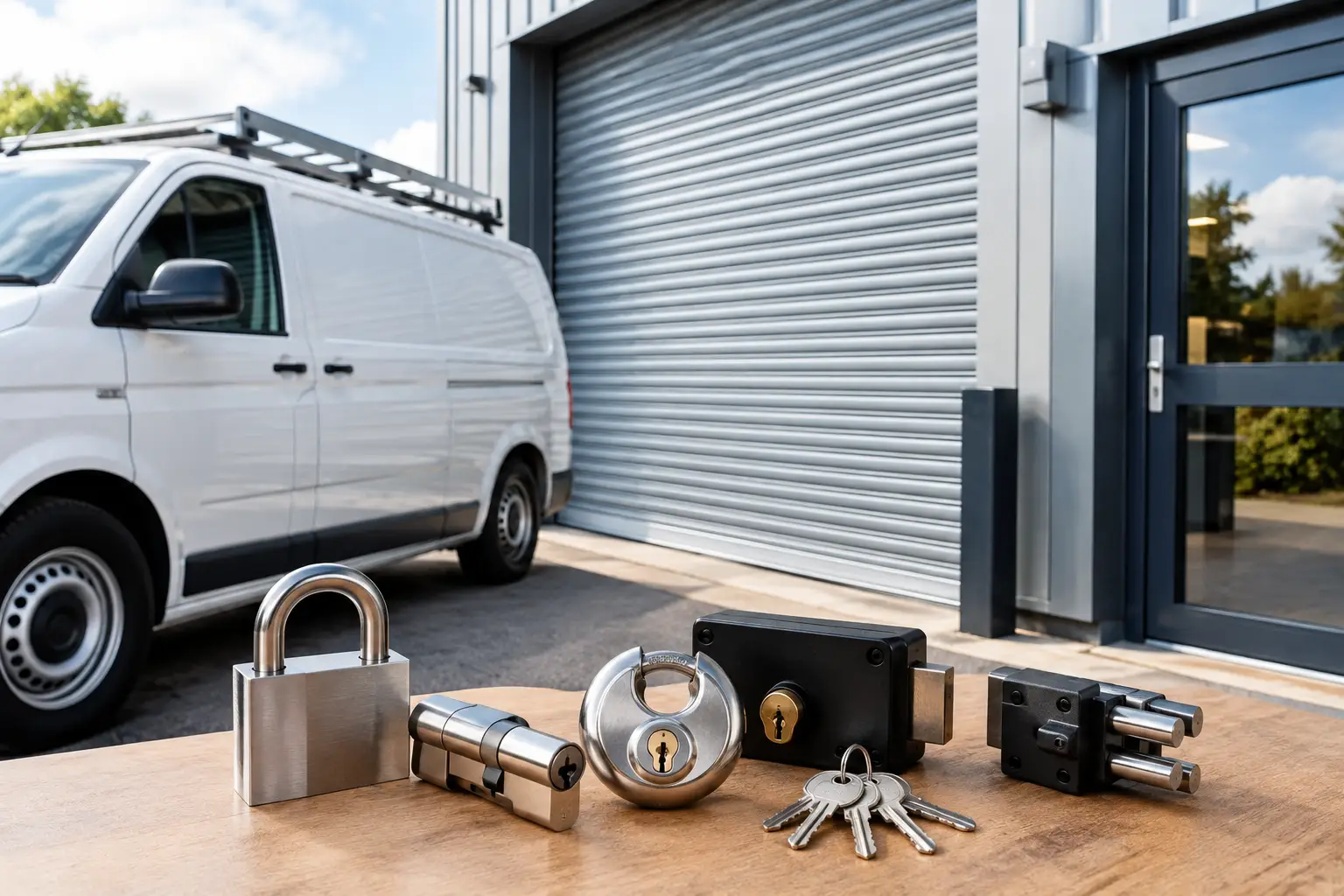
A shop door is often at its most vulnerable in the few minutes after closing. Staff are tired, the street is quieter, and a lock that has been stiff for weeks gets turned one more time. Choosing the best locks for shop doors is not about fitting the most expensive product available. It is about making forced entry difficult, meeting your insurer’s requirements, and ensuring the door can still be opened safely and reliably every morning.
The right answer depends on the door itself. A timber front door, aluminium shopfront, steel personnel door and roller shutter each need a different approach. A good commercial locksmith will assess the full entrance, not just the keyhole, because a high-specification lock is of little use if the frame, hinges or shutter guides are weak.
Best locks for shop doors: start with the door type
For a solid timber shop door, a British Standard mortice deadlock is usually a sensible starting point. Look for a lock that meets BS 3621, particularly where this is specified by your commercial insurance policy. These locks are designed for external doors and offer a strong level of resistance when correctly fitted into a sound door and frame.
If the door needs to be locked from outside but opened from inside without a key, a mortice sashlock may be more suitable. It combines a latch and deadbolt, which is useful for premises that are regularly entered during the day. The key point is that the locking arrangement must not obstruct a safe escape route.
Aluminium and glazed shopfront doors often use narrow-stile locks and euro profile cylinders. In this case, the cylinder deserves close attention. Standard cylinders can be vulnerable to snapping, drilling or picking, depending on their design and age. A TS 007 three-star cylinder, or a cylinder carrying the Sold Secure Diamond standard, offers far better protection against common attack methods. It should be fitted with compatible security furniture, rather than a decorative handle that leaves the cylinder exposed.
Steel personnel doors commonly take commercial mortice locks, heavy-duty sashlocks or deadlocks designed for metal sections. The lock needs to suit the thickness and construction of the door. Trying to force a domestic lock into a commercial steel door can create fitting problems and leave the door difficult to secure.
Do not overlook roller shutters
A roller shutter is an extra barrier, not an automatic guarantee of security. If the shutter can be lifted, pushed sideways or opened with a readily available key, it may give a false sense of protection.
For manual shutters, purpose-made shutter locks fitted low to the ground can prevent the curtain from being raised. Depending on the shutter design, this may be a pair of locking points, a heavy-duty bullet lock, or a ground-mounted locking device. The correct choice must work with the shutter’s guides and bottom rail. A loose padlock hanging from a hasp is often easier to cut or lever than owners expect.
Electric shutters need protection too. The external control box, override and any manual release should be secured against tampering. If an intruder can access the release mechanism, the quality of the shutter lock becomes less relevant. Shutter security should therefore be considered alongside the shop door behind it, rather than as a separate job.
Match the lock to the risk, not just the premises size
A small salon with limited stock may not need the same arrangement as a convenience store, pharmacy, jeweller or premises holding tools overnight. But any business can become a target if the entrance looks easy to defeat.
Think about what can be seen from the street, how long the premises are empty, whether there is rear access, and whether keys are held by several staff members. A rear fire door in an alley may need more attention than the smart-looking front entrance on a busy high street.
For many independent shops, a sensible layered arrangement includes a properly fitted primary lock, an anti-snap cylinder where applicable, suitable security handles, and a shutter lock if there is a roller shutter. This is generally more worthwhile than adding several cheap locks to the same weak door.
There is also a practical trade-off. Extra locking points can slow down opening and closing, create more keys to manage, and increase the chance that someone leaves one lock unsecured. The best setup is one your team can use consistently at the end of every shift.
Check your insurance wording before replacing a lock
Commercial insurance policies often include specific conditions for external doors, shutters and unoccupied periods. They may require a British Standard mortice deadlock on a timber door, a particular number of locking points, or shutters to be secured whenever the property is closed.
Do not assume that a lock marked as ‘high security’ meets the policy condition. Check the exact wording, especially if you have made changes to the shopfront or taken over a new unit. If there is a break-in, failure to meet a stated security condition could complicate a claim.
A locksmith can explain what is fitted and recommend an appropriate replacement, but the insurer remains the final authority on policy requirements. Keeping a record of the lock specification and installation is a sensible precaution.
Access control can be better than more keys
Keys are straightforward until they are copied, misplaced, not returned by a former employee, or passed between shifts without anyone keeping track. For premises with several staff, electronic access control can be a practical alternative to constantly changing cylinders.
A keypad, fob or card system lets you remove access when a staff member leaves without replacing every lock. It can also be paired with an electric release or magnetic lock on suitable doors. That said, electronic access control must be specified carefully. It needs a safe emergency exit arrangement, a reliable power solution and a manual override where appropriate.
For a single-owner shop with one or two trusted keyholders, a quality mechanical lock may remain the most dependable and cost-effective choice. Technology should solve a real access problem, not add unnecessary complexity.
Fire exits and panic hardware are different
One of the most serious mistakes in commercial security is treating a final exit door like any other external door. A fire exit must allow people to leave quickly without searching for a key. Fitting a deadlock, chain, padlock or improvised security bar that prevents escape can put lives at risk and may breach fire safety requirements.
Panic bars, push pads and emergency exit hardware can provide security while maintaining an escape route, but they need to be selected for the door, occupancy and use of the building. If a rear exit is being used for unauthorised access, the answer is not to obstruct it. It is to have the exit hardware and external security reviewed properly.
Signs a shop lock needs attention now
Commercial locks rarely fail without warning. A key that sticks, a handle that drops, a cylinder that turns loosely, or a shutter lock that needs repeated force are all signs to act before a morning opening becomes an emergency callout.
Do not keep using excessive force or spraying general-purpose oil into a lock. The wrong lubricant can attract dirt and make the mechanism worse. If a key has snapped, the door will not lock properly, or you have concerns after an attempted break-in, have the lock checked promptly. In some cases a repair is enough; in others, replacement is the safer and more economical option.
Get the fitting right
Even the best lock can be undermined by poor installation. The lock case must sit securely in the door, the keep must be firmly fixed to a sound frame, and the door should close without lifting, slamming or forcing the bolt into place. On uPVC and composite doors, the alignment of the multipoint mechanism is just as important as the cylinder fitted to it.
For shops in Reading, Berkshire and the surrounding area, Lock Solutions can assess a failed or outdated lock, explain the options in plain English and fit appropriate commercial hardware. There is no callout charge, and urgent lock problems can be attended to quickly.
Before locking up tonight, take a moment to test every entrance as an intruder would: does the door close tightly, does the key turn smoothly, and is the shutter properly secured? Small faults are much easier to put right before they become an open door after hours.