
A lock that suddenly needs a hard twist of the key is rarely just an annoyance. It is often an early warning that a component is worn, dry, misaligned or beginning to fail. Knowing how to fix stiff locks can save you a stressful lockout, but the first rule is simple: do not force the key or handle.
A little resistance may be harmless after a cold, wet spell. Resistance that gets worse, affects more than one key, or makes the door difficult to secure needs attention sooner rather than later. Excess pressure can snap a key in the cylinder, damage the lock internally, or leave the door locked shut when you need it open.
Start by working out when the lock feels stiff
The point at which the lock sticks gives a useful clue. Try the key gently with the door open first, provided it is safe to do so. If it turns smoothly when the door is open but becomes stiff when the door is shut, the issue is likely to be door alignment rather than the cylinder itself.
This is common with timber doors that expand in damp weather and with uPVC or composite doors that have dropped slightly on their hinges. The locking points may no longer line up cleanly with the keeps in the frame. You may notice that lifting the handle firmly, pushing or pulling the door, or raising it slightly makes the key turn more easily. That is a sign not to keep forcing it, but to have the alignment checked.
If the key is stiff whether the door is open or closed, the problem is more likely to be inside the cylinder or lock case. Dirt, old lubricant, corrosion and worn moving parts can all cause a key to drag or catch.
How to fix stiff locks with safe first checks
Before reaching for a spray, inspect the obvious causes. Look at the key for bent teeth, cracks, excessive wear or a build-up of dirt. A damaged key can feel like a failing lock, and it can break under pressure. If you have a spare key that has been kept safely indoors, test it gently. If the spare works well, stop using the worn key and arrange a good-quality replacement.
Next, check the keyway and the edge of the door for visible debris. Dust, grit and fragments from a worn key can interfere with the pins inside a cylinder. Do not poke paperclips, wire or other improvised tools into the keyway. They can dislodge parts or become stuck themselves.
Use a proper lock lubricant designed for cylinders, ideally a dry PTFE-based product. Apply only a small amount into the keyway, then insert and remove the key a few times before turning it gently. Wipe the key afterwards so excess product does not attract dirt.
Avoid using cooking oil, grease, household oil or a general-purpose oil as a long-term fix. They may make a stiff lock feel better briefly, but they can collect dust and turn into a sticky residue inside the mechanism. A standard water-displacing spray can also mask the issue without curing it. If the lock still catches after a light application of suitable lubricant, it needs a closer look.
Do not force a key that will not turn
If the key enters fully but will not turn, stop before you put your weight behind it. Keys are designed to operate a precise set of moving pins and levers, not to overcome a failing mechanism. A snapped key makes a straightforward repair more complicated, particularly if the door is locked.
Likewise, do not repeatedly slam a stiff door to make it latch. This can worsen a misalignment problem and place extra strain on the lock. Close it carefully and test whether light pressure towards, away from, up or down on the door changes how the key turns. That information will help a locksmith diagnose the fault quickly.
Stiff uPVC and composite door locks need extra care
Many uPVC and composite doors use a multipoint locking mechanism. When you lift the handle, hooks, rollers and bolts engage at several points along the door edge before the cylinder locks the handle in place. If the handle is stiff, drooping, hard to lift or will not lift all the way, do not assume the cylinder is the only problem.
A stiff multipoint lock may be caused by dropped hinges, incorrect keeps, a worn gearbox or internal mechanism failure. Spraying lubricant into the cylinder will not repair a faulty gearbox, and repeatedly forcing the handle can cause the mechanism to fail completely.
If the door is open and the handle will not lift smoothly, avoid shutting it until it has been checked. If it is already shut but will not lock properly, secure the property as best you can and arrange prompt help. Forcing a uPVC handle can turn a repair into a more involved replacement job.
Weather, age and usage all play a part
External door locks work through rain, frost, road dust and daily use. A front door used by a busy household, tenants or staff will naturally wear faster than a little-used internal door. Coastal air and exposed locations can also speed up corrosion, while changes in temperature can affect both the door and frame.
That does not mean every stiff lock needs replacing. A lock that is otherwise secure may only need cleaning, lubrication, hinge adjustment or a minor repair. However, a cylinder that feels gritty, turns inconsistently, spins freely, or has become loose should be assessed. These symptoms can indicate worn internal components, and they tend to deteriorate rather than improve.
When to call a locksmith rather than keep trying
A practical first check is sensible. Continuing to experiment once the lock resists is not. Call a locksmith if the key is bending, sticking or only working in one position; the lock works only when you lift, push or pull the door; the handle is difficult to lift; the key turns but the door will not open; or the cylinder is loose, damaged or spinning.
You should also seek help promptly after a break-in attempt. Even if the lock still operates, a forced cylinder, damaged handle or bent keeps can affect both security and reliable access.
For landlords and business owners, a stiff communal or external door lock is worth dealing with early. It can leave tenants unable to secure a property or prevent staff from opening safely. In these situations, waiting for a complete failure is usually the more disruptive and costly choice.
A locksmith can repair the cause, not just the symptom
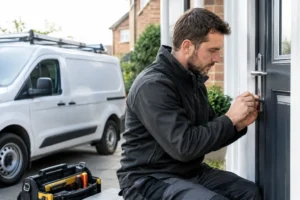
A professional locksmith will test the lock with the door open and shut, inspect the key and cylinder, and check the alignment of the door, frame and locking points. From there, the right solution may be a lock repair, a cylinder replacement, an adjustment to the door, or replacement of a worn multipoint mechanism.
There is a trade-off between a quick temporary improvement and a lasting repair. Lubrication may be enough for a dry but otherwise sound cylinder. It will not restore worn pins, a damaged cam, a broken gearbox or a door that has moved out of line. A clear diagnosis means you only pay for the work the lock actually needs.
If you are in Reading, Berkshire or the Thames Valley and a lock is becoming difficult to use, do not wait for the key to break or the door to jam. Lock Solutions can assess the fault, explain the options plainly and carry out the right repair or replacement, with no callout charge. A stiff lock is often your chance to act before a small warning becomes an urgent problem.